
Every foster, adoptive and kinship parent seeks to heal the hurts of the children they’re
parenting. But there are many others in the circle of a child’s life who can also play a pivotal role
in the healing process for children. The new book, “Healing Connections,” from ATTACh, an
international coalition promoting awareness of trauma and attachment disorders in children and
teens, is offering in-depth insight into creating a community healing approach for children.
The book is divided into three areas of connection: Brains and Bodies in Connection, The
Journey to Connection and Community in Connection. Within each of these areas are several
chapters providing detailed descriptions on everything from Complex Developmental Trauma to
Sibling Connections. The first section is key to helping caregivers and other practitioners
understand what trauma is and how it impacts children and their caregivers. Each chapter
provides clinical information woven together with personal experiences and examples, making it
easier for the reader to digest.
In the second section, Journey to Connection, addresses the different types of attachment
parents and children have and how that impacts relationships. It also explores the various types
of therapy to help children heal, including the factors that play into when you use those
therapies and why. In addition, there are chapters that speak to the unique role present or
absent fathers play in a child’s life and the significance of sibling relationships.
And the final section, Community in Connection, is a more broad exploration of community
impacts on a child’s care and healing from peer support to self-care practices for caregivers. In
addition, this chapter explores a couple of really unique topics not commonly discussed in a
book of this nature: the role of cultural connections in a child’s life and how trauma and
attachment can influence sexual orientation and gender identity.
This book includes a who’s who list of contributing writers and editors who are not only
clinicians, but also foster, adoptive and kinship caregivers, as well as parents whose children
were in the child welfare and youth justice systems and young people who experienced these
systems firsthand. This collaboration in a book is important to see all sides of the systems that
impact children and families.
“Healing Connections” isn’t light reading and some might find the content a little overwhelming
as it is relatively complex. The editors tried to balance the heavy content with personal
narratives and experiences that help to make it easier for others to dissect the complex
concepts. Because of this, readers may consider breaking up the reading over time as there is
just a lot of valuable information within the book that may take time to digest.

One of the most interesting parts of “Healing Connections” is the inclusion of cultural trauma
and healing aspects that can often sometimes be overlooked. Understanding the generational
and cultural traumas that impact children and their families is important when considering how
to help them heal from not just the traumas we may see through substance misuse, neglect or
poverty, but also the invisible traumas of family separation and other experiences in generations
long past.
— Reviewed by Kim Phagan-Hansel
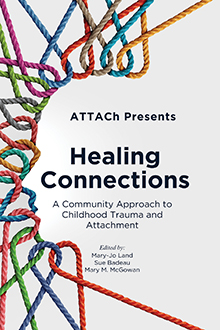
Healing Connections: A Community Approach to Childhood Trauma and Attachment
Edited by Mary-Jo Land, Sue Badeau and Mary M. McGowan
ATTACh, 2024, ISBN: 979-8-9912758-0-4, 443 pages, $30
About the Author

