
By Julian “JT” Dorsey
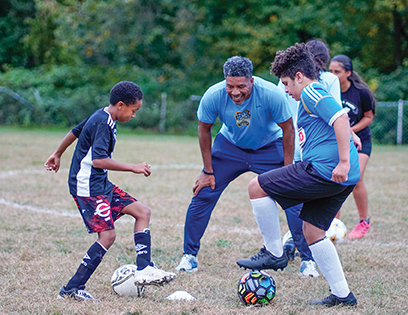
Nine-year-old Amir was used to being alone. He never played with the other kids in the neighborhood since his family moved around a lot, and he was chary of forming friendships only to lose touch soon. At school, he never socialized much and would avoid interactions as much as possible throughout the day. However, he was in the after-school 21st Century Program; a part of that involved playing soccer with JT Dorsey Foundation’s
Soccer for Success.
At first, Amir didn’t speak much during practice, stood slightly apart from the rest of the group or made reasons to leave the gym.
I think he didn’t want to play because he didn’t want to have fun or be part of something because he would just need to move again and be torn away from something he enjoyed.
After a few weeks, he finally started to participate. One day, coach-mentor Luke pulled him to one side and said, “I noticed you have good speed and footwork. Do you like to score goals?”
Amir was filled with joy that someone had noticed him; his eyes lit up and he joined the game. That day, he scored three goals in the scrimmage.
By the end of the season, Amir was not just playing soccer, he was showing leadership on and off the field.
The teachers at the school commented on the change they had seen in his behavior in the classroom and his academic performance.
He was proud to show coach Luke his report card. He formed friendships and even improved his relationship with his younger sister.
There are many kids like Amir who have benefited from Soccer for Success over the years. Just like him, it has given them a team, a voice and a chance to be a true part of something.
Soccer for Success
Children and youth in foster care face significant challenges their peers do not. They need more stability in their lives to provide a crucial foundation for their growth. There are many resources and ways to help them; I believe a team sport such as soccer is one of them.
Children like Amir can have a place to be seen, heard and belong. Soccer for Success does that.
I started the JT Dorsey Foundation in 2007 after realizing how my own childhood would’ve turned out without soccer. I grew up without many resources in an inner-city community.
My mother did not have the money to send me to soccer camp; it was my best friend’s dad who paid for my training. As I grew older, I saw many of my neighborhood peers end up in juvenile justice centers because they fell into a vicious trap of troubles.
I was able to avoid that because I was always at practice; I was also motivated to focus on my education because the coaches urged me to do so. It was almost like between practicing soccer and studying hard, I did not have the time to get into mischief.
Sporting Ties
Sports is not just about scoring goals and winning games — they build character and help youth try to better themselves in every way. The Foundation is my way of giving back to kids who are growing up like I did. We offer the Soccer for Success program for youth aged 5 to 19 across various locations in Pennsylvania such as Harrisburg, Lebanon, Coatesville, Pottstown and Philadelphia.
This program provides numerous benefits to all children but can be especially beneficial to children in foster care.
The program’s key components are promoting physical health, developing emotional well-being, improving social skills and providing consistent positive mentors.
For children in foster care, playing ball is a way to expend their frustration at being away from family and the familiarity of home.
Being on the field with other kids who are also going through crises and trouble helps forge shared bonds.
Apart from the interpersonal relationships, there are many benefits to participating in Soccer for Success. We place a lot of emphasis on improved physical health.
Regular physical activity is crucial for all children. Those in foster care may not always be welcomed to a foster home where they have adequate ways to exercise or play a sport.
Foster parents and kinship caregivers may struggle to provide the kids they care for with sports facilities. But physical exercise is essential during the growth phase of children.
Soccer for Success provides a consistent, safe environment where children can engage and help build their overall anaerobic capacity. This decreases their risk of childhood obesity, which is prevalent among children who have experienced instability in their living situations.
In fact, 83% of children who have participated in the Soccer for Success program have improved their health outcomes.
Coach-Mentors who Care
Connecting with a caring adult on a consistent basis is a significant benefit for children in foster care. We intentionally call our staff “coach-mentors.”
They do more than teach the sport; they also offer support, guidance and positive reinforcement.
These relationships can be impactful and transformative, providing children with the stability and encouragement they need to grow and succeed.
Participation in team sports has also been shown to improve mental wellness in children. The Soccer for Success curriculum is centered around social and emotional learning skills for youth.
Many of the kids who have dealt with Adverse Childhood Experiences (ACEs) find participating in Soccer for Success to be a form of therapy.
The program teaches children self-awareness, responsible decision-making, relationship skills, social awareness and self-management skills.
Our statistics show that 86% of Soccer for Success participants have stayed away from anti-social behavior, thus helping them be less anxious and stressed.
Team Spirit
Children in foster care frequently experience social isolation and difficulty forming relationships. We have seen that 88% of children in Soccer for Success work better on teams.
The program provides an opportunity for children to interact with peers in a positive environment.
They learn essential skills such as communication, cooperation and conflict resolution. Being a positive part of a team helps children feel a sense of belonging and community, which is often lacking in their daily lives.
The relationships they build with teammates and coach-mentors serve as an important development factor.
Kids return to the program year after year. Many of our alumni come back to coach the younger kids; some high school students volunteer as junior coaches-mentors.
Each camp or program varies in size between 30 to 200 kids. We coach more than 1,000 kids every season, while we have over 50 coach-mentors every year.
We receive funding from grants and local sponsors to run the program. Each child is provided a jersey and a soccer ball.
While the fees for the eight to 10 weeks program is $50, we offer many waivers and discount codes depending on the needs of each family.
Those kids who come to us via their after-school programs are not charged.
There are various partner agencies that we work with to ensure access to soccer does not suffer at the hands of missing funds.
Before I started playing soccer, I never really had a “place” to play or feel like I really belonged. Soccer gave me that. The JT Dorsey Foundation’s soccer programming is more than just coming out, kicking a ball and scoring goals. It offers a holistic approach to supporting children, especially kids in foster care.
To learn more about the JT Dorsey Foundation and how to sign up, visit our website at www.jtdorsey.org. You can also find us on Facebook @JTDorseyFoundation and Instagram @jtdf. •
Julian “JT” Dorsey is the founder of the JT Dorsey Foundation.