
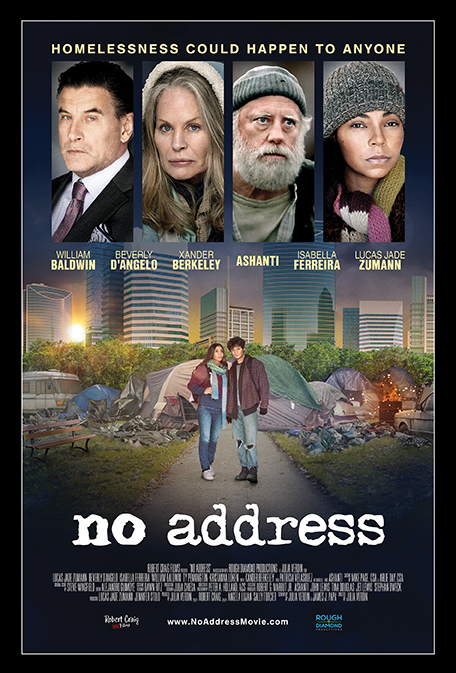
A new film from Robert Craig Films, “No Address” aims to shine a light on homelessness — the varied circumstances that can lead to housing instability, and some of the challenges that can snowball for people struggling with it. Foster care, domestic violence and child abuse are themes woven into the story, depicting the way these experiences can lead to homelessness. The film centers on a diverse group of people experiencing homelessness who band together as a family, sharing space and protecting one another as they battle a lack of resources, being targeted by a predatory and violent gang, and the constant threat of displacement by encampment sweeps.
The main character is Lauren, a teenager in foster care. We meet her as she’s graduating high school — a milestone moment tainted by finding garbage bags loaded with her possessions when she returns to her foster home after the ceremony. While walking the street, garbage bags in hand, she has the good fortune of running into two kind-hearted men who intervene as she’s being robbed and assaulted. They welcome her into their encampment, and she quickly becomes part of the family. Others in the encampment include a young man who fled home due to domestic and child abuse and a woman who’d fallen into instability after a dancing career due to unmet mental health challenges, and a veteran battling cancer, played by Ashanti.
The film’s antagonist, played by William Baldwin, is a real estate developer drowning in gambling debt that’s pushed his family behind on bills and mortgage payments. He plots to pull himself out of the red by landing a huge development project on the site of the encampment inhabited by Lauren and her found family. We watch as Baldwin’s character spews hatred at the homeless people sharing his community as he strives to displace them yet again — until his plans fail and he finds himself in their shoes. “No Address,” which filmmakers say is based on true events, succeeds in two key goals: showing how housing problems can befall anyone, even those who seem to have a stable or privileged life, and immersing viewers in the humanity of those impacted by this national crisis, in hopes of increasing public empathy.
But the film comes across as a bit too feel-good considering the subject matter, and the true statistics faced by people experiencing this condition — particularly youth with foster care histories. Lauren so quickly finding security and protection in this group of kind and relatively stable strangers is the exception, not norm. And that the whole group finds a warm, welcoming home at the end of the film adds to the sugar-coated, unrealistic tone.
The Robert Craig Films production team, though, is committed to using the art of filmmaking to address homelessness. They toured the country to learn more about the issue in preparation to create the film, interviewing nonprofit providers, policy advocates and others. They produced a documentary with footage from that learning tour — “Americans with No Address,” available for streaming on Prime Video — to provide a more in-depth education into the crisis.
Bestselling author Ken Abraham has also adapted the film into a novel, and an accompanying audiobook is narrated by Ashanti. A study guide provides a curriculum geared toward strategies to best serve people experiencing homelessness and eradicate the condition.

“No Address” is in theaters starting February 28. The filmmakers are donating 50% of all net proceeds from the film to nonprofits working to combat homelessness.
“No Address”
A Robert Craig Films production.
1 hour 48 minutes
— Reviewed by Sara Tiano
About the Author

